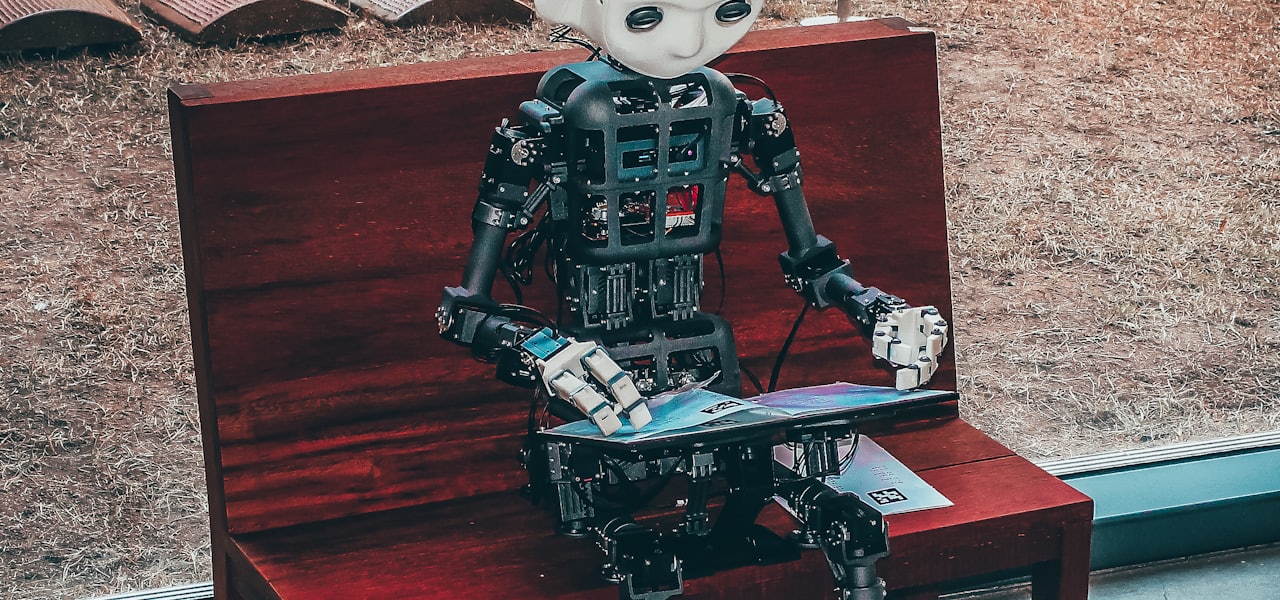
Humans have considered and tried to create non-biological life for at least 3,000 years. As seen in tales ranging from Pygmalion to Frankenstein, humanity has long been intrigued by the concept of artificial life. == Pre-computer == The earliest examples of artificial life involve sophisticated automata constructed using pneumatics, mechanics, and/or hydraulics. The first automata were conceived during the third and second centuries BC and these were demonstrated by the theorems of Hero of Alexandria, which included sophisticated mechanical and hydraulic solutions. Many of his notable works were included in the book Pneumatics, which was also used for constructing machines until early modern times. In 1490, Leonardo da Vinci also constructed an armored knight, which is considered the first humanoid robot in Western civilization. Other early famous examples include al-Jazari's humanoid robots. This Arabic inventor once constructed a band of automata, which can be commanded to play different pieces of music. There is also the case of Jacques de Vaucanson's artificial duck exhibited in 1735, which had thousands of moving parts and one of the first to mimic a biological system. The duck could reportedly eat and digest, drink, quack, and splash in a pool. It was exhibited all over Europe until it fell into disrepair. In the late 1600s, following René Descartes' claims that animals could be understood as purely physical machines, there was increasing interest in the question of whether a machine could be designed that, like an animal, could generate offspring (a self-replicating machine). However, it wasn't until the invention of cheap computing power that artificial life as a legitimate science began in earnest, steeped more in the theoretical and computational than the mechanical and mythological. == 1950s–1970s == One of the earliest thinkers of the modern age to postulate the potentials of artificial life, separate from artificial intelligence, was math and computer prodigy John von Neumann. At the Hixon Symposium, hosted by Linus Pauling in Pasadena, California in the late 1940s, von Neumann delivered a lecture titled "The General and Logical Theory of Automata." He defined an "automaton" as any machine whose behavior proceeded logically from step to step by combining information from the environment and its own programming, and said that natural organisms would in the end be found to follow similar simple rules. He also spoke about the idea of self-replicating machines. He postulated a made-up of a control computer, a construction arm, and a long series of instructions, floating in a lake of parts. By following the instructions that were part of its own body, it could create an identical machine. He followed this idea by creating (with Stanislaw Ulam) a purely logic-based automaton, not requiring a physical body but based on the changing states of the cells in an infinite grid – the first cellular automaton. It was extraordinarily complicated compared to later CAs, having hundreds of thousands of cells which could each exist in one of twenty-nine states, but von Neumann felt he needed the complexity in order for it to function not just as a self-replicating "machine", but also as a universal computer as defined by Alan Turing. This "universal constructor" read from a tape of instructions and wrote out a series of cells that could then be made active to leave a fully functional copy of the original machine and its tape. Von Neumann worked on his automata theory intensively right up to his death, and considered it his most important work. Homer Jacobson illustrated basic self-replication in the 1950s with a model train set – a seed "organism" consisting of a "head" and "tail" boxcar could use the simple rules of the system to consistently create new "organisms" identical to itself, so long as there was a random pool of new boxcars to draw from. Edward F. Moore proposed "Artificial Living Plants", which would be floating factories which could create copies of themselves. They could be programmed to perform some function (extracting fresh water, harvesting minerals from seawater) for an investment that would be relatively small compared to the huge returns from the exponentially growing numbers of factories. Freeman Dyson also studied the idea, envisioning self-replicating machines sent to explore and exploit other planets and moons, and a NASA group called the Self-Replicating Systems Concept Team performed a 1980 study on the feasibility of a self-building lunar factory. University of Cambridge professor John Horton Conway invented the most famous cellular automaton in the 1960s. He called it the Game of Life, and publicized it through Martin Gardner's column in Scientific American magazine. Norwegian-Italian mathematician Nils Aall Barricelli, who worked mainly at US institutions, was a pioneer in computer based simulation of biological processes such as symbiogenesis and evolution. == 1970s–1980s == Philosophy scholar Arthur Burks, who had worked with von Neumann (and indeed, organized his papers after Neumann's death), headed the Logic of Computers Group at the University of Michigan. He brought the overlooked views of 19th century American thinker Charles Sanders Peirce into the modern age. Peirce was a strong believer that all of nature's workings were based on logic (though not always deductive logic). The Michigan group was one of the few groups still interested in alife and CAs in the early 1970s; one of its students, Tommaso Toffoli argued in his PhD thesis that the field was important because its results explain the simple rules that underlay complex effects in nature. Toffoli later provided a key proof that CAs were reversible, just as the true universe is considered to be. Christopher Langton was an unconventional researcher, with an undistinguished academic career that led him to a job programming DEC mainframes for a hospital. He became enthralled by Conway's Game of Life, and began pursuing the idea that the computer could emulate living creatures. After years of study, he began attempting to actualize Von Neumann's CA and the work of Edgar F. Codd, who had simplified Von Neumann's original twenty-nine state monster to one with only eight states. He succeeded in creating the first self-replicating computer organism in October 1979, using only an Apple II desktop computer. He entered Burks' graduate program at the Logic of Computers Group in 1982, at the age of 33, and helped to found a new discipline. Langton's official conference announcement of Artificial Life I was the earliest description of a field which had previously barely existed: Artificial life is the study of artificial systems that exhibit behavior characteristic of natural living systems. It is the quest to explain life in any of its possible manifestations, without restriction to the particular examples that have evolved on earth. This includes biological and chemical experiments, computer simulations, and purely theoretical endeavors. Processes occurring on molecular, social, and evolutionary scales are subject to investigation. The ultimate goal is to extract the logical form of living systems. Microelectronic technology and genetic engineering will soon give us the capability to create new life forms in silico as well as in vitro. This capacity will present humanity with the most far-reaching technical, theoretical and ethical challenges it has ever confronted. The time seems appropriate for a gathering of those involved in attempts to simulate or synthesize aspects of living systems. Ed Fredkin founded the Information Mechanics Group at MIT, which united Toffoli, Norman Margolus, and Charles Bennett. This group created a computer especially designed to execute cellular automata, eventually reducing it to the size of a single circuit board. This "cellular automata machine" allowed an explosion of alife research among scientists who could not otherwise afford sophisticated computers. In 1982, computer scientist named Stephen Wolfram turned his attention to cellular automata. He explored and categorized the types of complexity displayed by one-dimensional CAs, and showed how they applied to natural phenomena such as the patterns of seashells and the nature of plant growth. Norman Packard, who worked with Wolfram at the Institute for Advanced Study, used CAs to simulate the growth of snowflakes, following very basic rules. Computer animator Craig Reynolds similarly used three simple rules to create recognizable flocking behaviour in a computer program in 1987 to animate groups of boids. With no top-down programming at all, the boids produced lifelike solutions to evading obstacles placed in their path. Computer animation has continued to be a key commercial driver of alife research as the creators of movies attempt to find more realistic and inexpensive ways to animate natural forms such as plant life, animal movement, hair growth, and complicated org
Moral outsourcing
Moral outsourcing is the placing of responsibility for ethical decision-making onto external entities, often algorithms. The term is often used in discussions of computer science and algorithmic fairness, but it can apply to any situation in which one appeals to outside agents in order to absolve themselves of responsibility for their actions. In this context, moral outsourcing specifically refers to the tendency of society to blame technology, rather than its creators or users, for any harm it may cause. == Definition == The term "moral outsourcing" was first coined by Dr. Rumman Chowdhury, a data scientist concerned with the overlap between artificial intelligence and social issues. Chowdhury used the term to describe looming fears of a so-called “Fourth Industrial Revolution” following the rise of artificial intelligence. Moral outsourcing is often applied by technologists to shrink away from their part in building offensive products. In her TED Talk, Chowdhury gives the example of a creator excusing their work by saying they were simply doing their job. This is a case of moral outsourcing and not taking ownership for the consequences of creation. When it comes to AI, moral outsourcing allows for creators to decide when the machine is human and when it is a computer - shifting the blame and responsibility of moral plights off of the technologists and onto the technology. Conversations around AI and bias and its impacts require accountability to bring change. It is difficult to address these biased systems if their creators use moral outsourcing to avoid taking any responsibility for the issue. One example of moral outsourcing is the anger that is directed at machines for “taking jobs away from humans” rather than companies for employing that technology and jeopardizing jobs in the first place. The term "moral outsourcing" refers to the concept of outsourcing, or enlisting an external operation to complete specific work for another organization. In the case of moral outsourcing, the work of resolving moral dilemmas or making choices according to an ethical code is supposed to be conducted by another entity. == Real-world applications == In the medical field, AI is increasingly involved in decision-making processes about which patients to treat, and how to treat them. The responsibility of the doctor to make informed decisions about what is best for their patients is outsourced to an algorithm. Sympathy is also noted to be an important part of medical practice; an aspect that artificial intelligence, glaringly, is missing. This form of moral outsourcing is a major concern in the medical community. Another field of technology in which moral outsourcing is frequently brought up is autonomous vehicles. California Polytechnic State University professor Keith Abney proposed an example scenario: "Suppose we have some [troublemaking] teenagers, and they see an autonomous vehicle, they drive right at it. They know the autonomous vehicle will swerve off the road and go off a cliff, but should it?" The decision of whether to sacrifice the autonomous vehicle (and any passengers inside) or the vehicle coming at it will be written into the algorithms defining the car's behavior. In the case of moral outsourcing, the responsibility of any damage caused by an accident may be attributed to the autonomous vehicle itself, rather than the creators who wrote the protocol the vehicle will use to "decide" what to do. Moral outsourcing is also used to delegate the consequences of predictive policing algorithms to technology, rather than the creators or the police. There are many ethical concerns with predictive policing due to the fact that it results in the over-policing of low income and minority communities. In the context of moral outsourcing, the positive feedback loop of sending disproportionate police forces into minority communities is attributed to the algorithm and the data being fed into this system--rather than the users and creators of the predictive policing technology. == Outside of technology == === Religion === Moral outsourcing is also commonly seen in appeals to religion to justify discrimination or harm. In his book What It Means to be Moral, sociologist Phil Zuckerman contradicts the popular religious notion that morality comes from God. Religion is oftentimes cited as a foundation for a moral stance without any tangible relation between the religious beliefs and personal stance. In these cases, religious individuals will "outsource" their personal beliefs and opinions by claiming that they are a result of their religious identification. This is seen where religion is cited as a factor for political beliefs, medical beliefs, and in extreme cases an excuse for violence. === Manufacturing === Moral outsourcing can also be seen in the business world in terms of manufacturing goods and avoiding environmental responsibility. Some companies in the United States will move their production process to foreign countries with more relaxed environmental policies to avoid the pollution laws that exist in the US. A study by the Harvard Business Review found that "in countries with tight environmental regulation, companies have 29% lower domestic emissions on average. On the other hand, such a tightening in regulation results in 43% higher emissions abroad." The consequences of higher pollution rates are then attributed to the loose regulations in these countries, rather than on the companies themselves who purposefully moved into these areas to avoid strict pollution policy.
Outline of automation
The following outline is provided as an overview of and topical guide to automation: Automation – use of control systems and information technologies to reduce the need for human work in the production of goods and services. In the scope of industrialization, automation is a step beyond mechanization. == Essence of automation == Control system – a device, or set of devices to manage, command, direct or regulate the behavior of other devices or systems. Industrial control system (ICS) – encompasses several types of control systems used in industrial production, including supervisory control and data acquisition (SCADA) systems, distributed control systems (DCS), and other smaller control system configurations such as skid-mounted programmable logic controllers (PLC) often found in industrial sectors and critical infrastructures. Industrialization – period of social and economic change that transforms a human group from an agrarian society into an industrial one. Numerical control (NC) – refers to the automation of machine tools that are operated by abstractly programmed commands encoded on a storage medium, as opposed to controlled manually via handwheels or levers, or mechanically automated via cams alone. Robotics – the branch of technology that deals with the design, construction, operation, structural disposition, manufacture and application of robots and computer systems for their control, sensory feedback, and information processing. == Branches of automation == === General purpose === Autonomous automation – autonomous software agents to adapt the controllers of computer controlled industrial machinery and processes Banking automation Broadcast automation Building automation – advanced functionality provided by the control system of a building. A building automation system (BAS) is an example of a distributed control system. Home automation – control system of a home. Office automation – the varied computer machinery and software used to digitally create, collect, store, manipulate, and relay office information needed for accomplishing basic tasks such as business process automation and robotic process automation. Console automation Database automation Integrated library system Laboratory automation === Specific purpose === Automated attendant Automated guided vehicle Autonomous mobile robot Automated highway system Automated pool cleaner Automated teller machine Automatic painting (robotic) Pop music automation Remotely operated vehicle Robotic lawn mower Telephone switchboard Vending machine == Fields contributing to automation == Cybernetics – the interdisciplinary study of the structure of regulatory systems. Cognitive science – interdisciplinary scientific study of the mind and its processes. It examines what cognition is, what it does and how it works. Robotics – the branch of technology that deals with the design, construction, operation, structural disposition, manufacture and application of robots and computer systems for their control, sensory feedback, and information processing. == History of automation == History of mass production – Prerequisites of mass production were interchangeable parts, machine tools and power, especially in the form of electricity. Mass production was popularized in the 1910s and 1920s by Henry Ford's Ford Motor Company, which introduced electric motors to the then-well-known technique of chain or sequential production. History of home automation == Automated machines == Machine to Machine OLE for process control (OPC) Process control – a statistics and engineering discipline that deals with architectures, mechanisms and algorithms for maintaining the output of a specific process within a desired range. Run Book Automation (RBA) Robot – a mechanical or virtual intelligent agent that can perform tasks automatically or with guidance, typically by remote control. == Automated machine components == Artificial intelligence – the intelligence of machines and the branch of computer science that aims to create it. Friendly artificial intelligence – an artificial intelligence that has a positive rather than negative effect on humanity, and the field of knowledge required to build such an artificial intelligence. === Automation tools === Artificial neural network (ANN) – mathematical model or computational model that is inspired by the structure or functional aspects of biological neural networks. Human machine interface (HMI) – operator level local control panel that monitors field devices Laboratory information management system (LIMS) – software package that offers a set of key features that support a modern laboratory's operations. Industrial control system – encompasses several types of control systems used in industrial production, including supervisory control and data acquisition (SCADA) systems, distributed control systems (DCS), and other smaller control system configurations such as skid-mounted programmable logic controllers (PLC) often found in the industrial sectors and critical infrastructures. Distributed control system (DCS) – control system usually of a manufacturing system, process or any kind of dynamic system, in which the controller elements are not central in location (like the brain) but are distributed throughout the system with each component sub-system controlled by one or more controllers. Manufacturing execution system (MES) – system that manages manufacturing operations in a factory, including management of resources, scheduling production processes, dispatching production orders, execution of production orders, etc. Programmable automation controller (PAC) – digital computer used for automation of electromechanical processes, such as control of machinery on factory assembly lines, amusement rides, or light fixtures. Programmable logic controller (PLC)A Programmable Logic Controller, PLC or Programmable Controller is a digital computer used for automation of electromechanical processes, such as control of machinery on factory assembly lines, amusement rides, or light fixtures. The abbreviation "PLC" and the term "Programmable Logic Controller" are registered trademarks of the Allen-Bradley Company (Rockwell Automation). PLCs are used in many industries and machines. Unlike general-purpose computers, the PLC is designed for multiple inputs and output arrangements, extended temperature ranges, immunity to electrical noise, and resistance to vibration and impact. Programs to control machine operation are typically stored in battery-backed-up or non-volatile memory. A PLC is an example of a hard real time system since output results must be produced in response to input conditions within a limited time, otherwise unintended operation will result. Supervisory control and data acquisition (SCADA) – generally refers to industrial control systems (ICS): computer systems that monitor and control industrial, infrastructure, or facility-based processes, as described below: Industrial processes include those of manufacturing, production, power generation, fabrication, and refining, and may run in continuous, batch, repetitive, or discrete modes. Simulation § Engineering Technology simulation or Process simulation == Social movements == Automation-related social movement – a movement that advocates semi- or fully automatic systems to provide for human needs globally. For example, automation of farming and food distribution throughout the world so that no one will go hungry. One goal is to automate all mundane labor, to free humans to engage in more creative activities (or less work). The Technocracy movement – social movement active from the Great Depression (1930s) to date that proposes replacing politicians and business people with scientists and engineers who have the technical expertise to manage the economy. The Zeitgeist Movement – movement advocating the replacement of the market economy with an economy in which all resources are equitably, commonly and sustainably shared. == Automation in the future == Android – a robot or synthetic organism designed to look and act like a human, and with a body having a flesh-like resemblance Technological singularity – the hypothetical future emergence of greater-than-human intelligence through technological means Semi-automation – using a centralized computer controller to orchestrate the activities of man and machine. == Automation-related publications == IEEE Spectrum – the flagship publication of the Institute of Electrical and Electronics Engineers (IEEE), explores the development, applications and implications of new technologies, and provides a forum for understanding, discussion and leadership in these areas. IEEE Transactions on Information Theory – peer-reviewed scientific journal published by the Institute of Electrical and Electronics Engineers (IEEE), focused on the study of information theory, the mathematics of communications, including computer communications, robotics communications, etc. IEEE Transactions on Control S
Lucy–Hook coaddition method
The Lucy–Hook coaddition method is an image processing technique for combining sub-stepped astronomical image data onto a finer grid. The method allows the option of resolution and contrast enhancement or the choice of a conservative, re-convolved, output. Tests with very deep Hubble Space Telescope Wide Field and Planetary Camera 2 (WFPC2) imaging data of excellent quality show that these methods can be very effective and allow fine-scale features to be studied better than on the unprocessed images. The Lucy–Hook coaddition method is an extension of the standard Richardson–Lucy deconvolution iterative restoration method. For many purposes it may be more convenient to combine dithered datasets using the Drizzle method.
Escapex
Escapex, stylized as escapex, was a mobile app developer specializing in white-label fan engagement apps for celebrities. It was founded by Sephi Shapira in 2014 and has raised $18 million in funding. It allows celebrities to reach fans directly, as well as receiving revenue from fans through its freemium model. == Overview == Shapira is Israeli and previously founded Interchan and MassiveImpact. He graduated from Ben-Gurion University of the Negev. The company has raised $18 million in funding. Its 2018 revenue was $5.5 million. In 2016, the company had 57 employees split between Tel Aviv and New York City. The company's General Manager is Joe Cuello, formerly an executive at MTV, then Chief Creative Officer at TuneCore. Their director of social engagement is Rafe Lopresti-Oakes. A press release from the company described the service as having a "proprietary loyalty program" which allows "monetization of social engagement through e-commerce and in-app advertising". App launches typically offered a contest for one fan to meet the celebrity. The app also allows Escapex to collect and monetize user profiles for advertising. The New York Times described the concept of Escapex, musing, "If people love you, why not make money from them?". == Notable apps == The company has created over 350 applications, including: Enrique Iglesias, June 2016 or earlier Akon, June 2016 or earlier Ricky Martin, June 2016 or earlier Rohan Marley and the Bob Marley estate, February 2017 Marc Anthony, March 2017 Prince Royce, March 2017 Jeremy Renner, March 2017, making over $35,000 per month in April 2019 Galen Gering, June 2017 Yandel, June 2017 Greg Vaughan, June 2017 Jason Thompson, June 2017 Niecy Nash, September 2017 Tyler Posey, September 2017 Osric Chau, January 2018 Chris D'Elia Alessandra Ambrosio, making over $35,000 per month in April 2019 Abigail Ratchford, making over $35,000 per month in April 2019 Amber Rose, making over $35,000 per month in April 2019 Dita Von Teese Tommy Chong === Bollywood stars === Escapex has a large roster of Bollywood celebrities, including: Sunny Leone, December 2016 Remo D'Souza, January 2017 Amy Jackson, March 2017 Kajal Aggarwal, March 2017 Nargis Fakhri, April 2017 Disha Patani Sonam Kapoor Salman Khan == Jeremy Renner app == Renner released a mobile app called "Jeremy Renner" (Android) and "Jeremy Renner Official" (iOS) in March 2017. FastCompany wrote extensively about Renner's app in April 2019, calling it "a surprising new kind of social media". The Ringer's Kate Knibbs, explaining how self-referential the app is, summarized it stating "Jeremy Renner’s Jeremy Renner app is the Jeremy Renner of apps." The community developed to include memes, selfies, and a "Happy Rennsday" event on Wednesdays. As early as October 2017 there were claims of censorship, bullying, and "contest-rigging". In September 2019, comedian Stefan Heck wrote about discovering that any replies through the app would appear as if they were sent by Renner himself in push notifications. Heck wrote about notifications making it appear Renner was a big enthusiast of "porno"; other users made it appear Renner was a big fan of Casey Anthony. Renner had to ask Escapex to shut down the app the following day, stating "The app has jumped the shark. Literally." In September 2020, comedian/writer Caroline Goldfarb and actress Sarah Ramos launched The Renner Files podcast, a six-part series investigating the Jeremy Renner app.
Edge inference
Edge inference is the process of running machine learning or deep learning models on local devices (edge devices) such as smartphones, IoT devices, embedded systems, and edge servers instead of centralized cloud computing infrastructure. A key feature of edge computing is edge inference, which allows for real-time data processing, low latency, and improved privacy by reducing the amount of data sent to remote servers.
Amaq News Agency
Amaq News Agency (Arabic: وكالة أعماق الإخبارية, romanized: Wakālat Aʻmāq al-Ikhbārīyah) is a news outlet linked to the Islamic State (IS). Amaq is often the "first point of publication for claims of responsibility" for terrorist attacks in Western countries by the Islamic State. In March 2019, Amaq News Agency was designated as a foreign terrorist organization by the United States Department of State. == History == Among the founders of Amaq was Syrian journalist Baraa Kadek, who joined IS in late 2013, Abu Muhammad al-Furqan, and seven others who originally worked for Halab News Network. According to The New York Times, it has a direct connection with IS, from which it "gets tips". Its name was taken from Amik Valley in Hatay Province, which is mentioned in a hadith as the site of an "apocalyptic victory over non-believers". Amaq News Agency was first noticed by SITE during the Siege of Kobanî (Syria) in 2014, when its updates were shared among IS fighters. It became more widely known after it began reporting claims of responsibility for terrorist attacks in Western countries, such as the 2015 San Bernardino attack, for which IS officially claimed responsibility the next day. An Amaq cameraman shot the first footage of the capture of Palmyra in 2015. Amaq launched an official mobile app in 2015 and has warned against unofficial versions that reportedly have been used to spy on its users. It also uses a Telegram account. It had a WordPress-based blog, but it was removed without explanation in April 2016. On 12 June 2016, IS claimed responsibility for the Pulse nightclub shooting through Amaq, without prior knowledge of the attack. The shooter, Omar Mateen had later pledged allegiance to IS via a phone call with emergency services. On 31 May 2017, a Facebook post announced Amaq's founder, Baraa Kadek AKA Rayan Meshaal, had been killed with his daughter by an American airstrike on Mayadin. The post was reportedly made by his younger brother. Reuters could not immediately verify this account. On 27 July 2017, the US confirmed that Kadek had been killed by a coalition airstrike near Mayadin between 25 and 27 May 2017. In June 2017, German police arrested a 23-year-old Syrian man identified only as Mohammed G., accusing him of communicating with the alleged perpetrator of the 2016 Malmö Muslim community centre arson in order to report to Amaq. On 21 March 2019, the U.S. Department of State officially deemed Amaq an alias of IS, and thus a Foreign Terrorist Organization. On 22 March 2024, the Islamic State claimed responsibility for the Crocus City Hall attack through Amaq, U.S. officials confirmed the claim shortly after. A day after the attack, Amaq published a video of the attack, filmed by one of the attackers. It showed the attackers shooting victims and slitting the throat of another, while the filming attacker praises Allah and speaks against infidels. == Character == Amaq publishes a stream of short news reports, both text and video, on the mobile app Telegram. The reports take on the trappings of mainstream journalism, with "Breaking News" headings, and embedded reporters at the scenes of IS battles. The reports try to appear neutral, toning down the jihadist language and sectarian slurs IS uses in its official releases. Charlie Winter of the Transcultural Conflict and Violence Initiative at Georgia State University, and Rita Katz of SITE Intelligence Group in Washington say Amaq functions much like the state-owned news agency of IS, though the group does not acknowledge it as such. Katz said it behaves "like a state media". Amaq appears to have been allowed to develop by IS as a way to have a news outlet that is controlled by the group but is somewhat removed from it, giving IS more of the appearance of legitimacy. == Reliability == According to Rukmini Callimachi in The New York Times: "Despite a widespread view that the Islamic State opportunistically claims attacks with which it has little genuine connection, its track record—minus a handful of exceptions—suggests a more rigorous protocol. At times, the Islamic State has got details wrong, or inflated casualty figures, but the gist of its claims is typically correct." According to Callimachi, the group considers itself responsible for acts carried out by people who were inspired by its propaganda, as well as acts carried out by its own personnel and in some instances, had claimed attacks before the identities of the killers were known. Graeme Wood writing in The Atlantic in October 2017, wrote "The idea that the Islamic State simply scans the news in search of mass killings, then sends out press releases in hope of stealing glory, is false. Amaq may learn details of the attacks from mainstream media ... but its claim of credit typically flows from an Amaq-specific source." An October 2017 article in The Hill, points to two false claims made in the summer of 2017, the Resorts World Manila attack and a false claim that bombs had been planted at Charles de Gaulle Airport in Paris. Also, a claimed IS connection to the 2017 Las Vegas shooting proved to be false. According to Rita Katz on the SITE Intelligence Group website, calling a terrorist a "soldier of the caliphate (warrior from the caliphate)" in a statement issued by Amaq, was the usual way in which IS indicated that it inspired an attack. Centrally coordinated attacks were usually described as "executed by a detachment belonging to the Islamic State", and were often announced by both Amaq and by IS' central media command. == Online presence == In November 2019, Belgian police said they had carried out a successful cyberattack on Amaq, thus leaving IS without an operational communication channel. However, Amaq has since regained online presence, primarily on dark web platforms to make it harder for law enforcement to take them down without physical access to the server hosting the specific platform.